

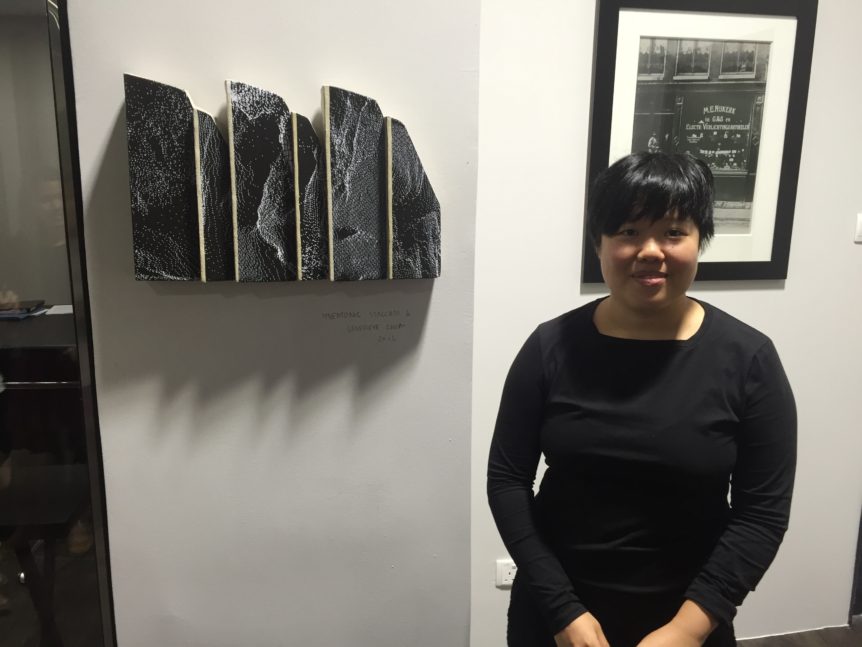
Working primarily through abstraction, Genevieve Chua pursues an unfurling narrative that is informed by natural history and linguistics. While contested notions of nature and wilderness persist across her work, the form taken by her exhibitions – whether installations, images or objects – is mediated through these processes. Selected solo exhibitions include Rehearsals for the Wilful (2016); Moths (2015); Parabola (2014); Cicadas Cicadas (Los Angeles, 2014); Birthing Ground not a Sound (Singapore, 2012); Adinandra Belukar at the Singapore Biennale (2011); Full Moon and Foxes at the Atelier, National Museum of Singapore (2009). She was a recipient of the NAC Georgette Chen Scholarship in 2003/4 and the Young Artist Award in 2012 conferred by the National Arts Council, Singapore.
Interview with Genevieve Chua
***
Nijvest (N): Tell us about your journey to becoming an artist?
Genevieve (G): I started learning watercolors when I was 14 at NAFA. At 18, I picked up painting with other mediums at LASALLE. The form and manner of painting subsequently changed for me. I began to embrace combining other mediums of painting for example, and the process of screen-printing stuck with me. For me, becoming an artist happens quite abruptly and spontaneously. I don’t know how or when it happened.
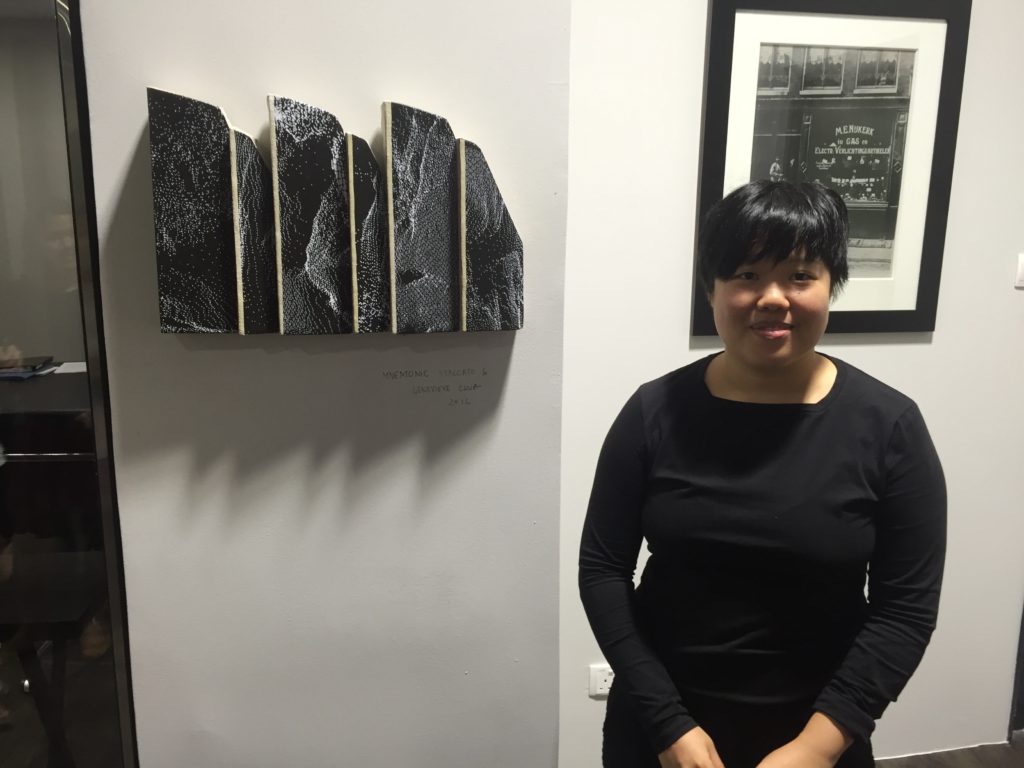
Genevieve Chua with her work, Mnemonic Staccato 6
N: Do you have a musical background as the piece at Nijvest is called Mnemonic Staccato 6?
G: No, I studied linguistics in university. I didn’t finish that degree but it left an impression on me because we had to listen to a lot of sound samples and speech samples of people. At that time, we were listening to a lot of Singlish and trying to validate that it is a language. One of the most basic things of Singaporean English is that, there is a lot of staccato, in nuance and in the emphasis of some words. Singlish is quite interesting because of that. A mnemonic is a system of remembering and 6 refers to the painting in 6 parts, hence the title Mnemonic, Staccato 6.
N: How do you, in terms of screen printing, show that the dots represent sound patterns?
G: The dots are sound patterns, basically, of people talking. I process and rotate these sounds as these visual forms and cues.
N: Why is the piece jagged, looking almost like a mountain?
G: It is not really, this one doesn’t have to do a lot with nature but it may be somehow related. When I first started screen-printing these types of dots, they were about samples of water, forests or moth wings vibrations. This work was specifically about language. I was also exploring how I could change painting in a way. All this time, I have always had this sensitivity for painting whether it was object-based work, photographs. I’m always really drawn to painting. But when it comes to painting on linen or canvas, for me as an artist, I would immediately think of it as one piece or a series of three/six hung separately. So I started thinking to myself, what if I have 6 parts of this painting but all looks like one. I have always paid careful attention to how I will build this painting. Yet I will use the same materials such as stretcher, linen and paint. So nothing has changed. It’s just that somehow, a lot of people think it’s a sculpture and that is important to me.
N: In your early work, you seem to concentrate on photography?
G: They are photographs but they are actually also paintings. I painted on top of the photographs. At the end of the day, somehow even if I start with a photograph, it ends up becoming a painting. I also don’t work on any editions.
N: Did your time in STPI (Singapore Tyler Print Institute), introduce you to print or were you already experimenting with that?
G: STPI was interesting because I could use special materials. A piece of mine was screen-printed with ground up lava rock because I was in a forest at the base of Mount Fuji where the soil and rocks were very fertile. So instead of squeege-ing ink which passes through the holes of the screen really easily, I put pigments and rocks into a stocking and rubbed the image in. When you see the image, some parts are appearing and disappearing at the same time.
N: In 2009, you were invited by the curator of M1 Fringe festival.
G: The Necessary Stage which is a theater company which organizes the Fringe Festival every year. They would invite international and local artists in theater , dance, music and visual arts. My work, Raised as a Pack of Wolves which was commissioned by the festival was a photo narrative, but also a performative gesture of androgynous girls who identified as being queer to perform a sequence of story-boarded images of feral children left to fend and find others like themselves.
N: Have you studied aboard?
G: No. But I travel a lot for residencies and exhibitions.
N: Would you say you are a Singaporean artist?
G: When I’m elsewhere, I do not really say where I am from but if I am showing an art piece I will say so. For example, I was working on a natural history piece so a lot of it comes from the wilderness across South East Asia or the tropics. So when I do show works like that, if the topics come up, I will explain where I am from and where its citizens have a drastically different idea of what a forest is (wild and romantic), compared to the reality of forests around them (manicured).
N: Do you ever talk about current issues such as the haze in your work?
G: Yes, there is one work about the direction of haze- which happened on the day of Mr Lee Kuan Yew’s passing.
N: Has the atmosphere of working as an artist in Singapore changed?
G: I think it is better now, in a sense that many of my contemporaries have studied abroad and exhibited outside of Singapore or Asia. That is really important because somehow, museums and institutions here sometimes have a really different view of how artists or art in Singapore should be aligned, that Asian artists should have Asian testament. They would promote works with more Asian centered themes. Sometimes it doesn’t have to be this way. Artists that have been in Singapore most of their lives have this view that their art pieces have to be somewhat Asian or Singaporean but it doesn’t have to be this way.
Share this Post